
Digital transformation
What M&A, Expansion and Asset Changes Are Exposing in Energy Planning
and how leading organisations are adapting
At the Wood Mackenzie Gas, LNG & The Future of Energy Conference, one theme came up repeatedly:
the disconnect between long-life assets and short-term market volatility.
Energy companies are making investment decisions on assets that will operate for 20–50 years — yet trying to plan them in a world where prices, demand, and regulation can shift in months.
So how are leading organisations adapting?
Forecasting alone isn’t enough
Traditional planning assumes a level of predictability that no longer exists.
Oil and gas prices fluctuate.
Energy transition policies evolve.
Market conditions change faster than planning cycles can keep up.
As a result, many organisations are moving away from single-point forecasts and towards scenario-based planning.
Instead of asking “what will happen?”, the better question is:
“what could happen, and are we ready for it?”
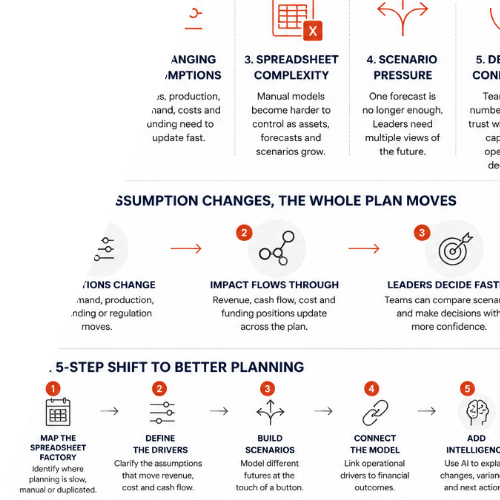
The hidden problem: spreadsheet-driven planning
In many organisations, planning is still heavily reliant on spreadsheets.
In one real-world example discussed at the event, a company was producing over 4,000 spreadsheets per year to support planning and forecasting processes.
This creates:
- Fragmented data across teams
- Version control issues
- Limited visibility at group level
- Slow response to change
And as organisations grow, through acquisitions, new assets, or restructuring, this complexity compounds.
Why this matters more now than ever
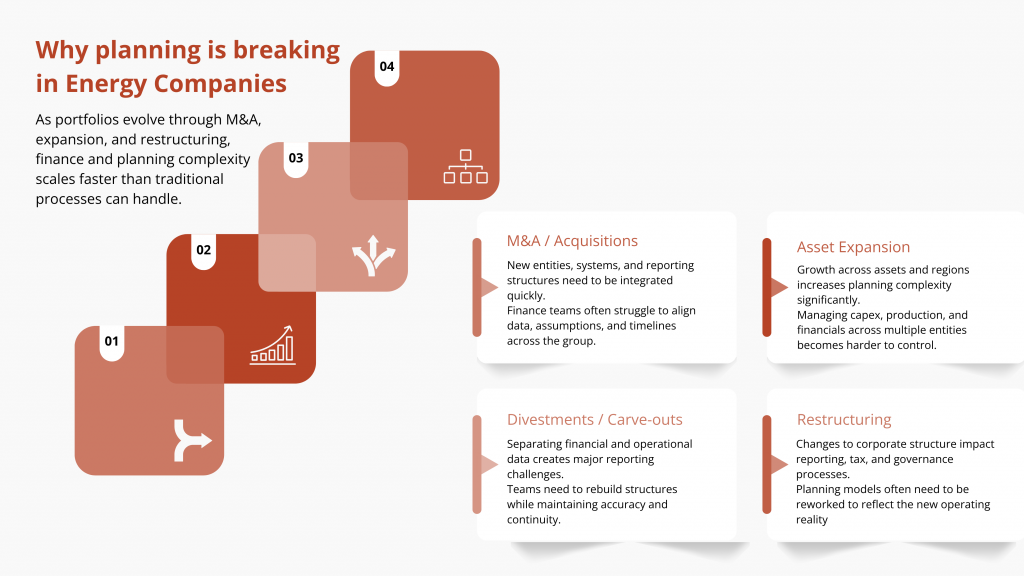
Recent industry activity highlights the scale of change:
- M&A and acquisitions introduce new entities, systems, and reporting requirements
- Portfolio expansions increase planning complexity across regions and assets
- Divestments and carve-outs require separation of financial and operational structures
- Corporate restructuring impacts reporting, tax, and governance frameworks
Each of these creates pressure on finance teams to adapt quickly, often with tools that weren’t designed for this level of change.
Featured content
Missed us at Wood Mackenzie 2026?

The best way to kickstart a digital transformation
Share this post
What leading companies are doing differently
Organisations that are adapting successfully are shifting towards:
1. Scenario-based planning
Running multiple models simultaneously to assess risk and opportunity
2. Integrated planning
Connecting financials, operations, and asset-level data in one place
3. Real-time visibility
Moving away from static reporting cycles to dynamic insights
4. Scalable systems
Replacing spreadsheet-heavy processes with connected planning platforms
The shift in mindset
This isn’t just a technology change, it’s a shift in how planning is approached.
From:
- Static forecasts
- Disconnected models
- Reactive decision-making
To:
- Continuous planning
- Connected data
- Proactive strategy
In conclusion:
The challenge isn’t that planning is becoming more complex,
it’s that businesses are outgrowing the tools and processes they’ve relied on for years.
The organisations that adapt fastest won’t be the ones with the most data,
but the ones that can turn that data into decisions, quickly and confidently.
Q&A: What Finance Leaders Are Asking Right Now
Q: How do you actually plan when forecasts are so unreliable?
A: The shift we’re seeing is away from relying on a single forecast. Instead, leading organisations are building multiple scenarios, for example, different price environments, demand levels, or regulatory outcomes, and stress-testing decisions against each. It’s less about being “right” and more about being prepared.
Q: We already have planning processes in place, why change them?
A: Many existing processes were designed for more stable environments. They often rely on spreadsheets and manual consolidation, which can work at smaller scale. But as organisations grow, through acquisitions or new assets, those processes become harder to maintain, slower to update, and more difficult to trust.
Q: Where does planning typically break down as companies scale?
A: The biggest issues tend to be:
Multiple disconnected models across teams
Lack of a single source of truth
Time delays in consolidating and validating data
Difficulty adapting plans quickly when conditions change
These challenges become much more visible after events like acquisitions or restructuring.
Q: How do acquisitions or asset changes impact finance and planning?
A: They introduce new entities, systems, and reporting requirements. Finance teams often have to integrate data from different sources, align planning assumptions, and maintain group-level visibility, all while continuing day-to-day operations. Without the right structure, this quickly becomes complex and resource-intensive.
Q: What does “integrated planning” actually mean in practice?
A: It means connecting financial planning with operational drivers, such as production, capex, and asset performance – in one environment. Instead of separate models for each area, everything feeds into a single, consistent view, making it easier to understand the impact of decisions across the business.
Q: Is moving away from spreadsheets really necessary?
A: Spreadsheets aren’t the problem, over-reliance on them is. They’re flexible and familiar, but they don’t scale well. As complexity increases, organisations typically reach a point where spreadsheet-based processes create more risk and inefficiency than they solve.
Q: What does good planning look like in today’s environment?
A: The organisations doing this well tend to have:
Scenario-based models that can be updated quickly
Connected data across finance and operations
Clear visibility at both asset and group level
The ability to respond to change without rebuilding models from scratch
Q: Where do most companies start when improving planning?
A: It usually begins with identifying where complexity is causing friction, often in consolidation, reporting, or scenario modelling. From there, the focus is on simplifying and connecting those processes so that planning becomes faster, more reliable, and easier to scale.
Q: How does this link to finance transformation initiatives?
A: Planning is often a central part of finance transformation. As organisations look to modernise finance functions, improving planning processes, particularly around visibility, speed, and accuracy, is typically one of the key priorities.
What could better planning and reporting look like?
Whether you’re dealing with slow reporting cycles, spreadsheet-heavy processes, or limited visibility across the business, there are practical ways to improve without replacing your core systems. We can walk you through what that looks like based on similar organisations.


Why most finance teams aren’t AI ready

Simplifying data transfers