
Finance transformation
When does it make sense to implement Oracle EPM?
Key signs your finance team has outgrown spreadsheets and manual processes

Many organisations don’t start out looking for a new planning or reporting tool.
But over time, as the business grows, finance teams often find themselves relying on spreadsheets, manual processes, and disconnected systems to manage planning, forecasting, and reporting.
That’s usually the point where Oracle Enterprise Performance Management starts to make sense.
So how do you know when you’ve reached that stage?
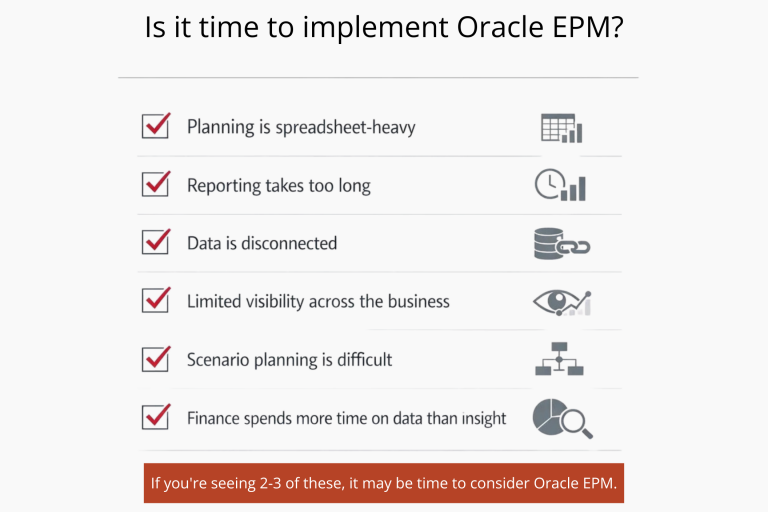
1. Planning and forecasting rely heavily on spreadsheets
For many finance teams, Excel becomes the default tool for budgeting and forecasting.
At first, it works. But as complexity increases, it often leads to:
- multiple versions of the truth
- time spent consolidating data manually
- limited visibility across the business
If planning cycles are slow or difficult to manage, it’s a strong sign that a more structured solution is needed.
2. Reporting takes too long
Month-end and reporting cycles can become increasingly time-consuming, especially when data needs to be pulled from multiple systems.
Common challenges include:
- manual data collection
- repeated checks and reconciliations
- delays in delivering reports to leadership
According to Gartner, finance teams are under increasing pressure to deliver faster insights while maintaining accuracy, something that becomes difficult with manual processes.
We typically see organisations consider Oracle EPM when a few of these start to show up:
Featured content
What is enterprise performance management

The best way to kickstart a digital transformation
Share this post
3. There’s limited visibility across the business
As organisations grow, finance teams need a clearer view across departments, regions, and business units.
Without a centralised system, this often results in:
- siloed data
- inconsistent reporting
- difficulty understanding overall performance
Oracle EPM brings this information together, making it easier to see what’s happening across the business in one place.
4. Scenario planning is difficult
Being able to answer “what if?” questions quickly is becoming more important.
For example:
- What happens if costs increase?
- How will revenue changes impact forecasts?
- What’s the financial impact of different business decisions?
In spreadsheet-driven environments, this can take significant time.
With Oracle EPM, finance teams can run scenarios more easily and respond faster.
5. Finance is spending more time on data than insight
One of the clearest signs is when finance teams are:
- spending more time gathering data than analysing it
- focused on fixing numbers rather than interpreting them
The role of finance is shifting towards being more strategic, but that’s difficult to achieve with manual processes.
6. The business is growing or becoming more complex
Growth often introduces:
- new entities or regions
- more data sources
- more complex reporting requirements
What worked before may no longer scale.
Implementing Oracle EPM helps create a more structured and scalable approach to planning and reporting.
What changes after implementing Oracle EPM?
In practice, organisations typically see:
- faster planning and forecasting cycles
- more reliable and consistent reporting
- improved visibility across the business
- less reliance on spreadsheets
- more time spent on analysis and decision-making
Oracle EPM doesn’t replace core ERP systems like SAP S/4HANA, it complements them, improving the processes around planning and reporting.
In conclusion:
There’s rarely a single moment when a company decides to implement Oracle EPM.
Instead, it’s usually a combination of small frustrations:
- spreadsheets becoming harder to manage
- reporting taking longer
- visibility becoming limited
- decision-making slowing down
Companies should consider implementing Oracle EPM when planning, forecasting, and reporting become too manual, slow, or complex to manage effectively using spreadsheets or disconnected systems.
FAQ:
When should a company implement Oracle EPM?
When finance processes such as planning, forecasting, and reporting become inefficient, manual, or difficult to scale.
What problems does Oracle EPM solve?
It improves financial planning and reporting by reducing manual work, increasing visibility, and enabling better decision-making.
Does Oracle EPM replace ERP systems?
No. Oracle EPM works alongside ERP systems to enhance planning, forecasting, and reporting processes.
Looking to explore what this could look like for your organisation?
If you’re currently facing challenges with planning, reporting, or forecasting in SAP, we’d be happy to share what we’ve seen work in similar organisations.


Why most finance teams aren’t AI ready

Simplifying data transfers