
Industry insights
Why organisations are moving to Oracle Cloud EPM
The top reasons organisations move to Oracle Cloud EPM

Key drivers behind the shift to modern performance management
Finance teams today are under increasing pressure to deliver faster insights, more accurate forecasts, and clearer financial reporting. As a result, many organisations are modernising their planning and reporting environments by adopting Oracle Cloud EPM (Enterprise Performance Management).
Oracle Cloud EPM helps organisations manage planning, budgeting, forecasting, consolidation, and financial reporting in a connected cloud platform.
Recent industry data highlights several key reasons why organisations are moving to Oracle Cloud EPM. The main drivers are not just cost savings, they are about capability, scalability, and improving how finance teams operate.
Below are the most common reasons companies are adopting Oracle Cloud EPM
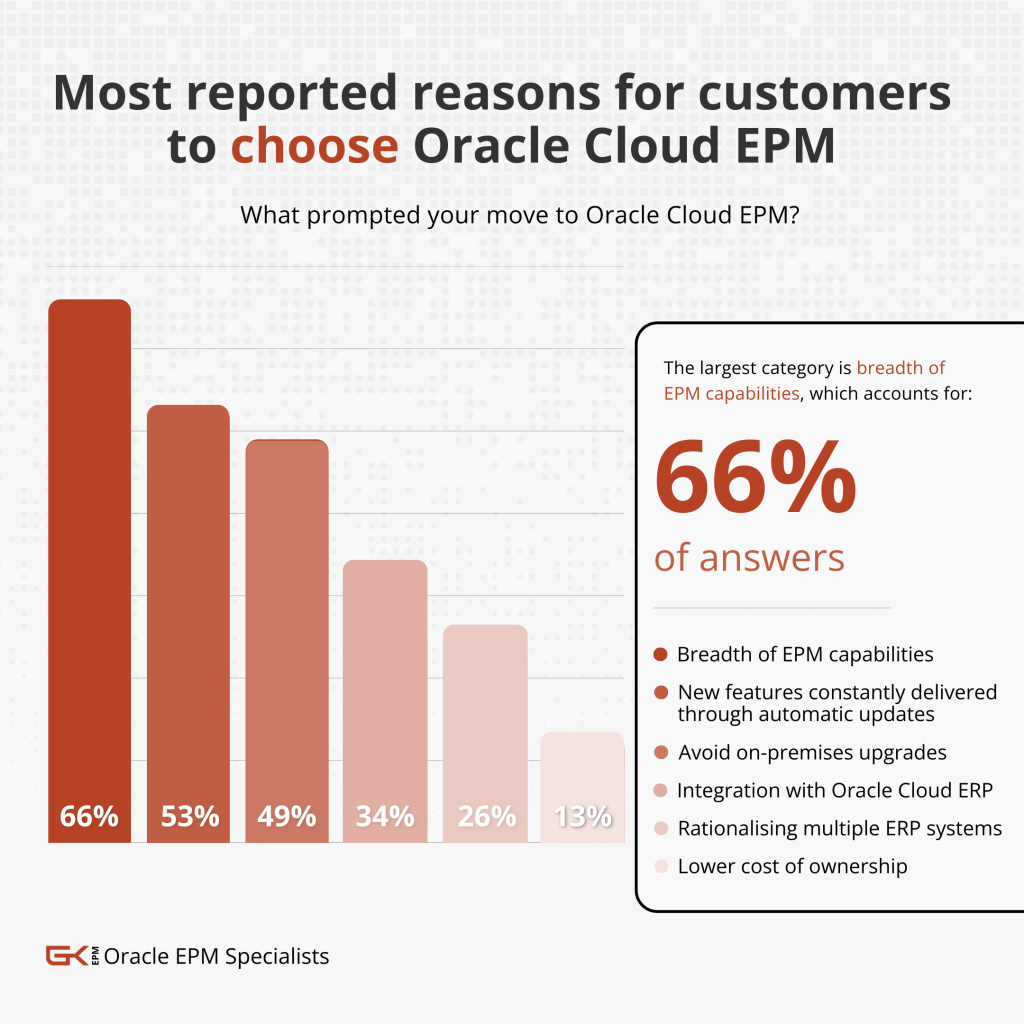
The top reasons organisations move to Oracle Cloud EPM
1. Access to a Broader Range of EPM Capabilities (66%)
The most frequently cited reason organisations adopt Oracle Cloud EPM is the breadth of capabilities available in a single platform.
Modern finance teams require much more than basic budgeting tools. They need an integrated environment that supports:
Financial planning and budgeting
Forecasting and scenario modelling
Financial consolidation and close
Management and statutory reporting
Profitability and cost analysis
When these processes are spread across spreadsheets and disconnected systems, finance teams often spend more time reconciling numbers than analysing them.
Oracle Cloud EPM brings these capabilities together, enabling finance teams to move from manual coordination toward strategic financial analysis and planning.
Featured content
What is enterprise performance management

The best way to kickstart a digital transformation
Share this post
2. Continuous Innovation Through Automatic Updates (53%)
One of the major advantages of Oracle Cloud EPM is its cloud-based delivery model.
Unlike traditional on-premises systems that require major upgrade projects, Oracle Cloud EPM provides regular automatic updates that deliver new functionality throughout the year.
This allows organisations to:
Access new features without complex upgrade projects
Reduce IT maintenance and operational overhead
Continuously improve planning and reporting processes
For many finance teams, this shift from large, disruptive upgrades to continuous innovation is a significant benefit.
3. Avoiding On-Premises Upgrade Cycles (49%)
Nearly half of organisations moving to Oracle Cloud EPM cite the desire to move away from on-premises infrastructure.
Maintaining on-premise systems often involves:
Server management
Hardware upgrades
Long upgrade cycles
Significant IT involvement
Cloud EPM removes much of this complexity. Instead of managing infrastructure, organisations can focus on improving financial processes and decision-making.
4. Integration with Oracle Cloud ERP (34%)
For organisations already running Oracle Cloud ERP, moving to Oracle Cloud EPM provides stronger alignment between operational systems and financial planning.
When ERP and EPM systems are well integrated:
Data flows automatically between systems
Reconciliation effort decreases
Reporting becomes more reliable
Financial close cycles can accelerate
However, successful integration requires the right architecture. Without well-designed data integration processes, finance teams can still face manual data preparation challenges.
5. Rationalising Multiple EPM Systems (26%)
Over time, many organisations accumulate multiple planning tools across different departments or regions.
This can create issues such as:
Duplicate planning processes
Inconsistent reporting structures
Governance challenges
Increased operational complexity
By moving to a single EPM platform like Oracle Cloud EPM, organisations can standardise processes and create a more unified financial planning environment.
6. Lower Total Cost of Ownership (13%)
Interestingly, lower cost of ownership ranks lowest among reported drivers.
While cloud platforms can reduce infrastructure costs, most organisations are primarily motivated by improvements in:
Capability
efficiency
scalability
financial insight
In other words, the goal is not simply to reduce costs, but to build a more effective finance function.
What This Means for Modern Finance Teams
The move toward Oracle Cloud EPM reflects a broader shift in the role of finance.
Finance teams are increasingly expected to provide:
forward-looking forecasts
scenario modelling for strategic decisions
faster financial close cycles
real-time performance insight
Delivering these capabilities requires more than spreadsheets or disconnected systems.
It requires a structured performance management platform supported by reliable data integration.
Why Integration Is Critical for EPM Success
One of the most important and often underestimated – factors in EPM success is how enterprise systems integrate with the EPM platform.
Financial data often comes from systems such as:
SAP
Oracle ERP
Microsoft Dynamics
Operational databases
If these integrations are slow, manual, or unreliable, finance teams can quickly return to spreadsheet-based processes.
Clean and automated integrations help ensure that:
data is available when finance teams need it
reports reflect the latest information
planning cycles run efficiently
forecasts are based on reliable data
Organisations that gain the most value from Oracle Cloud EPM typically treat integration architecture as a core part of their EPM strategy.
If your organisation is experiencing challenges such as:
heavy reliance on spreadsheets for planning
multiple disconnected planning tools
slow financial close processes
complex data preparation before reporting
growing reporting and forecasting demands
It may be worth reviewing whether your current EPM environment is supporting your finance team effectively.
Modern platforms like Oracle Cloud EPM are designed to help finance teams operate more efficiently, deliver better insights, and support strategic decision-making.
Frequently Asked Questions About Oracle Cloud EPM
What is Oracle Cloud EPM?
Oracle Cloud EPM (Enterprise Performance Management) is a cloud platform that helps organisations manage financial planning, budgeting, forecasting, consolidation, and reporting in a single integrated environment.
Why are organisations moving to Oracle Cloud EPM?
Organisations move to Oracle Cloud EPM to access advanced planning capabilities, reduce reliance on spreadsheets, simplify financial consolidation, and avoid the complexity of maintaining on-premises systems.
What are the main benefits of Oracle Cloud EPM?
Key benefits include:
integrated planning and forecasting
faster financial close processes
automated reporting
continuous cloud updates
improved data visibility across finance teams
Does Oracle Cloud EPM integrate with SAP and other enterprise systems?
Yes. Oracle Cloud EPM can integrate with enterprise systems such as SAP, Oracle ERP, Microsoft Dynamics, and other databases, allowing organisations to consolidate financial data and streamline reporting.
Thinking about your current EPM setup?

Why most finance teams aren’t AI ready

Simplifying data transfers