
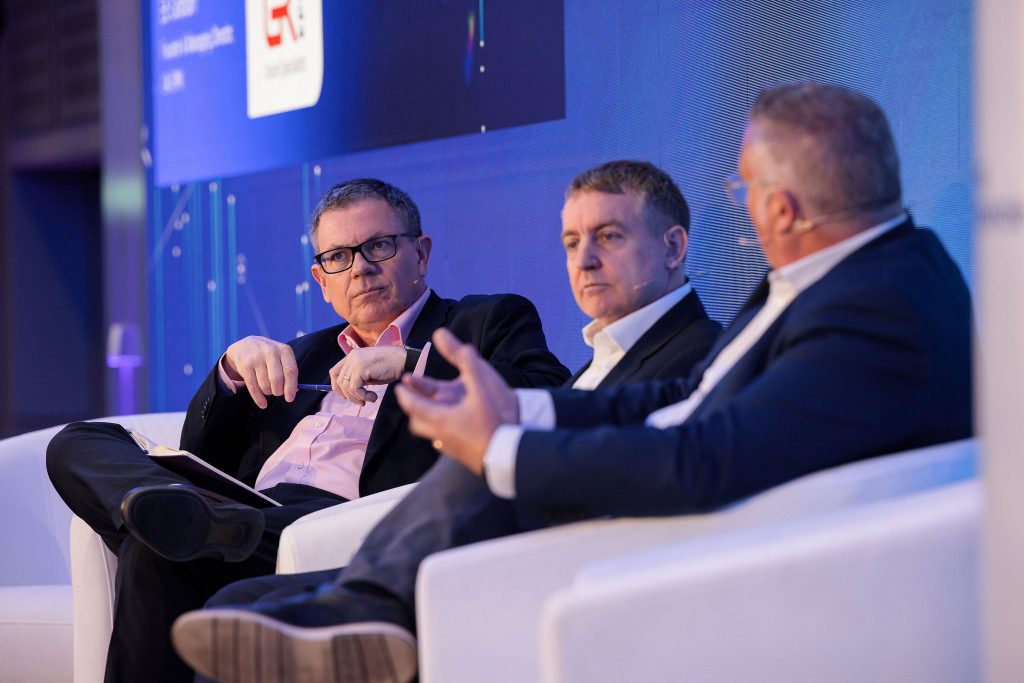
GK EPM presented on stage alongside Oracle at Wood Mackenzie’s Gas & LNG Conference for a fireside chat titled:
“From supply & demand to planning a 50-year asset in a world that changes every second.”
The session featured:
Ed Graham
Founder & Managing Director, GK EPM
Andy King
Senior Director, Product Management, Oracle EPM
Together, they explored how connected, driver-based and AI-supported planning can help energy companies move beyond static spreadsheets and respond faster to changing market conditions.

5 Key Takeaways from GK EPM and Oracle’s Fireside Chat at Wood Mackenzie’s Gas & LNG Conference
At Wood Mackenzie’s Gas & LNG Conference, GK EPM joined Oracle for a fireside chat exploring a challenge facing many energy and asset-heavy organisations today: how do you plan long-term assets in a world where assumptions can change constantly?
The session, titled “Planning a 50-year asset in a world that changes every second”, brought together Ed Graham, Founder and Managing Director of GK EPM, and Andy King, Senior Director of Product Management at Oracle EPM.
The discussion focused on the growing need for more dynamic, connected and scenario-led planning across the energy sector. From long-life assets and volatile market assumptions to spreadsheet complexity, AI and decision confidence, the session highlighted how planning is becoming a strategic capability rather than just a finance process.
Here are five key takeaways from the conversation.
1. Long-term asset planning needs to become more dynamic
Energy companies often make decisions around assets that can last for decades. Upstream assets, pipelines, LNG terminals and other major infrastructure projects require long-range planning across production, capital expenditure, operating costs, funding, cash flow and end-of-life considerations.
However, the assumptions behind those plans can change quickly.
During the session, Ed Graham explained that long-term asset planning needs the ability to model different scenarios on demand and change assumptions when conditions move. This is especially relevant in gas and LNG, where companies are planning assets with multi-decade lives while operating in volatile markets.
The key point is simple: long-term planning can no longer mean static planning.
Organisations need planning models that can flex as prices, demand, production, costs, funding and regulatory assumptions change.
2. Spreadsheet-heavy planning does not scale
One of the clearest examples from the session was the challenge of spreadsheet-based planning at scale.
Ed shared an example of an asset-heavy energy organisation managing planning across more than 100 assets. Each asset had its own spreadsheet, with monthly forecasts and multiple scenario versions. At that scale, the organisation was looking at roughly:
100+ assets
× 12 monthly forecasts
× 3–4 scenario versions
= around 4,000 Excel workbooks per year
The issue is not simply the number of files. It is the difficulty of maintaining control, consistency, speed and confidence across every version of the plan.
Spreadsheets remain useful, but they are not designed to operate as robust enterprise planning systems for complex, long-range, multi-scenario planning.
As the number of assets, scenarios and assumptions grows, the “spreadsheet factory” becomes harder to manage.
3. Scenario modelling is becoming essential for better decisions
The session also highlighted the importance of scenario modelling and sensitivity analysis.
For energy organisations, one forecast is no longer enough. Leaders need to understand how different assumptions could affect the business. What happens if prices move? What if production changes? What if demand shifts? What if costs rise? What if funding assumptions change?
Ed described the need to model different price and volume assumptions, while Andy King linked this to the broader discipline of stress testing and risk modelling used in other sectors, including financial services.
The message for energy organisations is clear: the ability to model multiple scenarios quickly is becoming a competitive advantage.
Better scenario modelling gives leaders a stronger basis for capital allocation, funding decisions and long-term investment planning.
4. Connected planning links operational drivers to financial outcomes
A major theme from Oracle’s perspective was the need to move away from planning in silos.
Andy King described the role of connected planning in bringing together demand, supply, cost, capital expenditure, funding, equity, cash flow and other financial elements into a more integrated planning framework.
This matters because operational changes do not stay operational. A change in production, price, demand, cost or funding can affect revenue, cash flow, profitability and investment priorities.
Connected planning helps organisations understand those relationships more clearly.
Instead of manually updating disconnected spreadsheets, teams can use a structured planning model where operational drivers flow through to financial outcomes. This creates a stronger foundation for decision-making because leaders can see not only the final numbers, but also the drivers behind them.
5. AI is moving planning from forecasting to explanation
The final part of the discussion looked at the future of planning and the role of AI.
The speakers discussed how planning tools are already supporting predictive forecasting and variance analysis. But the next step is more powerful: helping teams understand what changed, why it changed and what actions should be considered.
AI is not just about producing a forecast faster.
Its value lies in helping teams interpret the forecast, explain variances, identify drivers and support better decision-making.
Andy also discussed the move towards more natural language interaction, where users could ask questions of the planning system rather than relying on one person to run models manually in Excel.
This points towards a future where planning becomes more accessible, more interactive and more embedded into everyday decision-making.
The bigger takeaway
The session reinforced a clear message: planning is no longer just about producing an annual forecast.
For energy and asset-heavy organisations, planning is becoming a core business capability.
The organisations that succeed will not simply be the ones with the most data. They will be the ones that can turn changing assumptions into informed decisions faster.
That means moving from spreadsheet-heavy planning to connected, scenario-led planning models that support long-range assets, changing assumptions, faster reforecasting and stronger decision confidence.
GK EPM helps energy and asset-heavy organisations design and implement planning solutions using Oracle EPM, supporting the move from manual planning processes to connected, driver-based and scenario-led planning.
Why this matters now
The LNG and gas market is being shaped by volatility, supply disruption, price uncertainty, changing demand patterns, financing shifts and growing pressure to build resilience.
Wood Mackenzie’s wider conference takeaways highlighted several major market themes, including elevated near-term LNG price risk, medium-term LNG demand growth, supply diversification, affordability pressures, China’s changing role as a market balancer, evolving finance models and increased trading complexity.
For energy companies, these are not just market observations.
They are planning challenges.
Every shift in price, demand, production, regulation, financing or supply availability can affect revenue, cash flow, capital allocation and long-term investment decisions.
That means planning can no longer be slow, manual or disconnected.
It needs to become dynamic, scenario-led and connected across the business.
What the fireside chat covered
- Why long-term asset planning is becoming harder
- How energy companies can plan assets that may last decades
- Why spreadsheet-heavy planning processes are becoming difficult to scale
- How driver-based planning links operational assumptions to financial outcomes
- Why scenario modelling and sensitivity analysis are now essential
- How connected planning improves decision-making
- How Oracle EPM supports enterprise-wide planning
- How GK EPM helps organisations design and implement tailored planning models
- How AI is moving from forecasting into variance explanation and decision support
Disconnected planning
Spreadsheet-heavy processes reduce forecasting confidence and slow down decision-making
Market volatility
Rapid changes across energy markets require more agile scenario modelling capabilities
Complex reporting
Multi-entity finance operations create reporting inefficiencies and limited visibility
Access more resources
You can access the following post-event resources:
Full fireside chat recording
Watch the full GK EPM and Oracle discussion from Wood Mackenzie’s Gas & LNG Conference.
Event infographic
View a visual summary of the key themes from the session, including volatility, scenario planning, connected planning and AI-supported decision-making.
Full event breakdown
Receive a wider breakdown of the Wood Mackenzie Gas & LNG Conference themes, including LNG market volatility, supply diversification, affordability, finance, trading and the implications for planning.
Why GK EPM
Connected finance transformation with Oracle EPM
GK EPM helps organisations modernise planning, forecasting and financial reporting through senior-led Oracle EPM delivery
Our directors come from industry finance roles. We’ve lived planning cycles, reporting deadlines and system inefficiencies ourselfves
Clients work directly with senior professionals
A system is only succesful if teams use it. We focus on embedding EPM into daily finance processes
Speak with the GK EPM team
Want to understand how your current planning process would perform in a volatile market?
Book a short planning maturity review with GK EPM to discuss:
- Where spreadsheet-heavy planning may be slowing decision-making
- How quickly your team can update scenarios
- Whether your operational and financial plans are properly connected
- How Oracle EPM could support long-range asset planning
- Where AI and automation could improve speed, insight and confidence