
Digital transformation
The 4,000-spreadsheet problem: what happens when scenario planning scales
Is your EPM system truly delivering?
Spreadsheet complexity grows multiplicatively. If an organisation manages many assets, planning periods, forecast versions and scenarios in separate workbooks, the number of files and hand-offs can become unmanageable. The “4,000 spreadsheets” example discussed by GKEPM and Oracle at Wood Mackenzie illustrates why Oracle EPM Planning needs centralised assumptions, versions and calculations as the business scales.
The most useful planning problems can often be expressed with simple arithmetic.
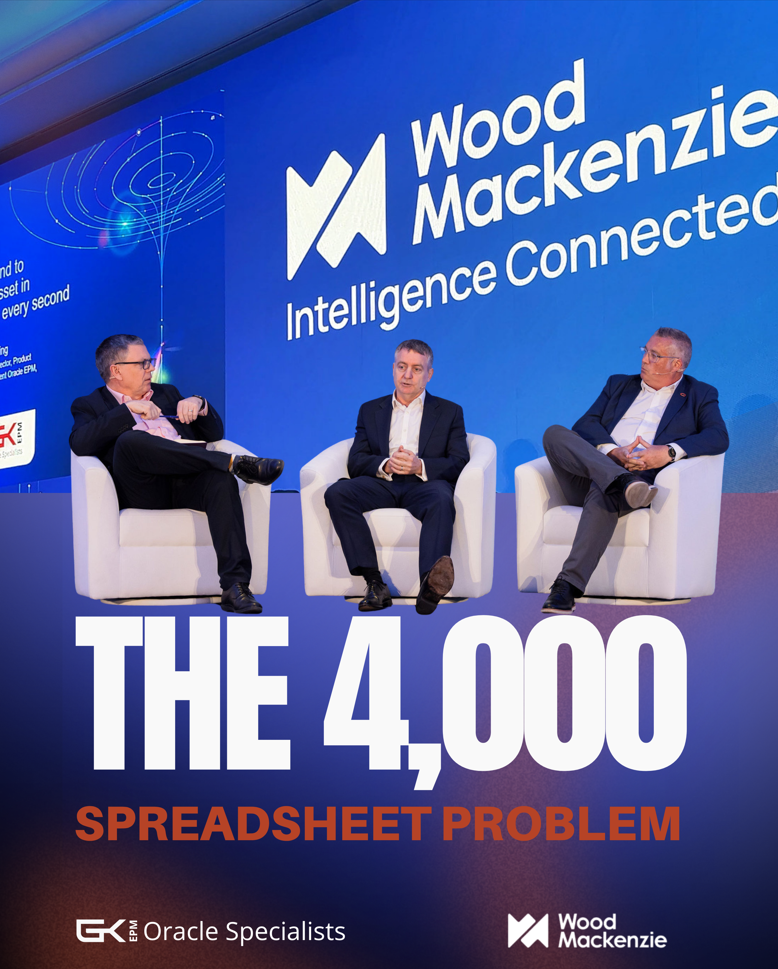
At the Wood Mackenzie Gas & LNG / Future of Energy conference, the GKEPM/Oracle discussion used an example built around approximately 100 assets, a monthly forecast and three or four scenarios. The practical result was described as a “4,000 spreadsheet” problem. That number should not be read as a statistic about the industry – it is an illustration of how fast spreadsheet-based planning expands.
Why does planning complexity multiply rather than add?
Suppose finance manages 100 assets, multiple forecast periods, a base case, an upside case, a downside case, and perhaps an additional stress or strategic case. If the planning process creates separate files or copies for combinations of those dimensions, every new requirement multiplies the coordination problem. And that is before adding entities, currencies, contributors, approvals or acquisitions.#
What’s the real cost of thousands of spreadsheets?
Four thousand files do not matter because they consume disk space. They matter because each copy introduces questions about control: Which assumptions are common? Which formulas changed? Which version is approved? Has every asset used the same price deck? Did a local file overwrite an updated volume? Can finance reproduce the number that went to management?
The cost shows up in reconciliation, review, error investigation, duplicated data entry, slower scenario turnaround, and dependency on specific individuals.
Featured content
What is enterprise performance management

The best way to kickstart a digital transformation
Share this post
How do you centralise without losing flexibility?
A more scalable approach separates common assumptions and logic from the individual views finance users need. Price decks, FX assumptions, scenario definitions and core calculation logic can be governed centrally. Asset owners can still contribute the drivers they own. Finance can still analyse in Excel if that is the preferred interface. What changes is the location of control.
GKEPM’s NEO Planning case describes a move from spreadsheet-based forecasting to a structured Oracle EPM Planning application with integrated quantity and financial forecasting, versioning and what-if analysis, the key design principle is not to remove flexibility, but to remove unnecessary duplication.
How do you benchmark duplication in your own process?
You do not need to count every spreadsheet. Instead, ask how many times the same assumption is manually copied. If the same commodity-price assumption is maintained in 20 asset files, the risk is not “20 spreadsheets”, it is 20 opportunities for those files to diverge. If the same scenario definition is recreated by several teams, the risk is inconsistent interpretation.
A scalable architecture stores common assumptions once, controls their use and lets the organisation view the consequences at the required level.
In conclusion:
Four thousand spreadsheets sounds like an extreme edge case until you realise it comes from a perfectly ordinary starting point, 100 assets, a monthly cycle, and a handful of scenarios. Nobody designs a planning process to end up there; it accumulates one additional asset, one additional version, one additional scenario at a time, and each step feels reasonable on its own.
The way out isn’t a rule about file counts, it’s a different question: how many times is the same assumption being typed in more than once? That’s the real multiplier, and it’s also the thing a centralised Oracle EPM Planning architecture is built to remove, without taking away the flexibility finance teams actually rely on.
Leading organisations focus on:
How many spreadsheets is “too many” for an oil and gas planning process?
There’s no fixed threshold – a single badly controlled workbook can be risky, while a large number of well-designed analysis files can be manageable. The better indicator is how often the same assumption gets manually re-entered across files, since that’s what creates divergence risk.
Can Oracle EPM Planning reduce the number of spreadsheets finance maintains?
Yes. By centralising price decks, FX assumptions, scenario definitions and calculation logic in one governed application, Oracle EPM Planning removes the need to duplicate a workbook per asset, period or scenario combination, finance can still analyse in Excel via Smart View, but the source of truth sits centrally.
What’s the first step in reducing spreadsheet duplication?
Identify which assumptions are currently being manually copied across multiple files, rather than counting spreadsheets. A single commodity-price assumption re-entered in 20 asset files is 20 opportunities for those files to diverge, that’s the practical starting point for centralisation.
Does centralising assumptions in Oracle EPM mean asset owners lose control of their own data?
No. Asset owners can still contribute and own the drivers specific to their asset, what changes is where common, shared assumptions like price decks and scenario definitions are governed, not who owns the operational detail underneath them.
Thinking about your current EPM setup?
We don’t just implement Oracle EPM, we make sure your team achieves 100% success. From adoption to everyday use, we ensure your system drives real results, helping you prevent or overcome the 5 silent EPM failures highlighted in this article

Why most finance teams aren’t AI ready

Simplifying data transfers