
Industry insights
What should an Oil & Gas life-of-field financial model include?
A practical checklist covering production, price, CAPEX, tax, cash flow and Oracle EPM
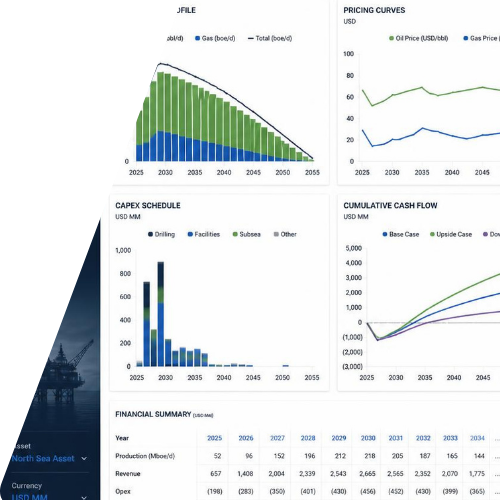
A life-of-field financial model built on Oracle EPM Planning should connect the physical profile of the asset with the financial outcomes management needs to assess. At minimum, that normally means production volume, realised price, revenue, OPEX, CAPEX, tax/fiscal assumptions, cash flow, timing and decommissioning. It should also support versions and scenarios so assumptions can change without rebuilding the model.
A life-of-field model is useful only if it translates the way an asset operates into the way the business makes decisions.
That sounds obvious, but many planning environments grow in layers. Production data sits in one system. Price decks live in spreadsheets. CAPEX is managed by project teams. Finance then pulls the outputs together into a forecast. The result may still produce the right total, but it becomes slow to update and difficult to explain.
A robust life-of-field model, and the Oracle EPM implementation partner that builds it, should make the links explicit.
Why start with the production profile?
Start with volume. The model needs a time-phased view of expected production or sales volumes at the level at which management actually takes decisions, for example field, asset, hub or other operational hierarchy.
In our NEO Energy Planning case study, we demonstrate integrated financial and operational forecasting, including BOE, MSCF and therms. It provides a clear example of how operational volume data can be directly connected to financial planning, removing the need for finance teams to manually re-key data and improving accuracy and efficiency.
How should price and commercial assumptions be modelled?
A volume without a price does not create a revenue forecast.
The model should distinguish between the assumptions that matter to the business: benchmark price, realised price, different products, contractual terms or other commercial adjustments where applicable. The exact design will depend on the organisation.
The important point is that price assumptions should be visible, versioned and easy to flex.
What makes revenue logic transparent?
Revenue calculations should be transparent enough that finance can explain how a change in volume or price reaches the P&L and cash forecast.
If the logic is hidden inside individual spreadsheets, scenario analysis becomes slower and auditability weakens.
How should OPEX and unit economics be structured?
Operating cost should be modelled at a level that supports decision-making. For some organisations that may mean fixed and variable cost. For others, asset-level or cost-centre drivers will matter more.
The key question is not how many dimensions the model contains. It is whether the organisation can understand what is driving cost and profitability.
Why does CAPEX timing matter as much as CAPEX amount?
CAPEX is not only a total amount. Timing matters.
A change in project schedule can alter cash requirements and returns even if the ultimate project cost remains the same. A planning model should therefore allow finance to see the effect of cost and timing changes together.
Featured content
What is enterprise performance management

The best way to kickstart a digital transformation
Share this post
How should tax and fiscal assumptions be governed?
Fiscal treatment should be modelled as a governed assumption, not buried in dozens of worksheets. In the UK, for example, finance teams now need to monitor the proposed Oil and Gas Revenue Levy framework that is intended to replace the Energy Profits Levy when it ends.
The point is not to turn EPM into a tax engine. It is to make sure the financial plan can respond when the assumptions used by tax or treasury change.
Why does cash flow matter more than accounting profit?
A life-of-field plan should move beyond accounting profit. Capital decisions ultimately require visibility of cash timing.
The Wood Mackenzie discussion explicitly linked stronger cash-flow modelling with better funding conversations.
How should decommissioning be included in the model?
A model that stops at production does not represent the full asset life.
For UKCS operators, decommissioning is material and increasingly active. The NSTA’s 2026 update estimates the remaining UKCS decommissioning programme at £43.4bn. That does not mean every company should copy a generic cost curve, it means end-of-life obligations need to sit inside the same long-range view used for asset economics.
Why versions and scenarios, not just one model?
A life-of-field model should preserve more than one answer.
Finance should be able to distinguish base case, downside, upside, budget, latest forecast and other approved versions without duplicating the entire model manually.
Why governance and traceability matter most
Every critical assumption needs ownership.
A model can be technically sophisticated and still be weak if nobody knows who approved the production curve, price deck or CAPEX revision. The strongest life-of-field models therefore combine calculation with governance: source, owner, version, date and scenario.
In conclusion:
A life-of-field model is not just a longer spreadsheet, it is a different category of planning problem. It has to hold production, price, cost, tax and decommissioning assumptions together over decades, preserve multiple versions and scenarios, and stay traceable enough that finance can explain any number in it. Ten components, production, price, revenue logic, OPEX, CAPEX timing, tax, cash flow, decommissioning, versioning and governance, is a practical checklist for reviewing whether your current model is built to last, or whether it was built for the size of business you had a few years ago.
The organisations that get the most value from Oracle EPM Planning are the ones that treat this as an architecture decision first and a software decision second: mapping ownership and data flow before configuring a single calculation. If that mapping hasn’t happened yet, it’s worth doing before the next round of asset additions, acquisitions or fiscal changes makes the gap harder to close.
Frequently Asked Questions
What’s the difference between a financial model and a life-of-field model? A standard financial model typically covers a budget year or short-term forecast horizon. A life-of-field model extends across the full production life of an asset — sometimes 30-50 years — and connects operational quantity data to financial outcomes so long-term decisions like decommissioning and capital allocation can be tested.
Do I need Oracle EPM to build a life-of-field model, or can I do this in Excel? Excel can build a life-of-field model for a single asset with limited scenarios. The limitation appears as assets, versions and scenarios multiply, at that point a governed Oracle EPM Planning environment becomes more practical because it centralises assumptions, versioning and integration rather than relying on file duplication.
How is decommissioning cost included in an Oracle EPM oil and gas model? Decommissioning is typically modelled as a long-term cash obligation tied to asset end-of-life timing, sitting within the same scenario and version structure as the rest of the life-of-field forecast, rather than as a separate, disconnected calculation.
How long does it take to build a life-of-field model in Oracle EPM? Timelines vary with the number of source systems and whether quantity forecasting (BOE, MSCF, therms) is included alongside financials, but most upstream Oracle EPM Planning implementations run 12-20 weeks, often phased with core financial planning first.
Unsure whether your current life-of-field model is scalable?
You can now request a review of the architecture, data flows, assumptions and scenario process before you commit to a wider finance transformation.


Why most finance teams aren’t AI ready

Simplifying data transfers