
Industry insights
The 50-year asset problem
How resilient is your current planning architecture?
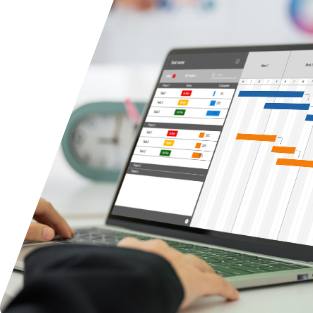
The problem with planning a long-life oil and gas asset is not that finance needs to predict the next 30 or 50 years precisely. It is that the organisation needs a model that can absorb changing assumptions, production, commodity price, cost, project timing, tax and funding, and show their effect on cash flow and returns without rebuilding the forecast every time the market moves.
At Wood Mackenzie’s Gas & LNG / Future of Energy conference, one line captured a problem familiar to almost every energy finance team: how do you plan a 50-year asset in a world that changes every second?
The phrase is deliberately provocative, but the planning issue behind it is practical. Oil and gas assets are long-lived. Development decisions, production profiles, capital programmes and decommissioning obligations can extend across decades. The assumptions used to value those assets do not have the same lifespan.
Commodity prices move. Production curves change. Costs are revised. Project schedules slip or accelerate. Fiscal regimes evolve. Funding conditions change. Acquisitions add assets and entities. Divestments remove them.
A long-range plan therefore cannot be treated as a static answer. It needs to behave more like a controlled model of the business.
Start with the operating drivers
For an upstream asset, the financial plan begins before the P&L. Finance needs a view of the physical and commercial drivers that create the numbers.
At the Wood Mackenzie session, GKEPM and Oracle discussed volume by asset, production curves and price assumptions as central inputs to long-life planning. The same discussion also highlighted CAPEX, OPEX and end-of-life cash flows. [Source: S1, timestamps 00:01:50–00:02:32 and 00:10:40–00:12:08]
A practical model will normally need to connect several layers:
- production or sales volume;
- price assumptions;
- revenue;
- operating expenditure;
- capital expenditure;
- tax and fiscal assumptions;
- working-capital and funding effects where relevant;
- cash flow and returns;
- decommissioning or end-of-life obligations.
The precise design will differ by company. That is the point. A planning model should reflect how that organisation actually creates value rather than force every asset into a generic template.
The objective is not one perfect forecast
A single number can create false confidence.
If a base case assumes one commodity-price path, one production profile and one CAPEX schedule, it tells management what happens under that combination of assumptions. It does not tell management what happens if the assumptions are wrong.
That is why long-range planning needs to make scenario changes easy rather than exceptional.
The useful questions are often simple:
- What if price is 10% lower?
- What if production starts six months later?
- What if CAPEX increases?
- What if a field underperforms?
- What if an acquisition is added to the portfolio?
- What if a tax or royalty assumption changes?
A mature planning environment should allow finance to change those drivers in a controlled way and see the effect flow through the model.
Connect the life of the asset to the life of the forecast
GKEPM’s work with NEO provides a useful example of this principle in practice. The published case study describes an Oracle EPM Planning implementation that integrated financial and quantity forecasting, including BOE, MSCF and therms, and supported both in-year and life-of-field forecasts. It also introduced versioning and what-if analysis and integrated source data from SAP and EnergySys. [Source: S2]
The relevance is broader than one system implementation. The case demonstrates the architecture finance needs when the forecast spans different time horizons and different types of data.
Monthly or quarterly forecasting supports near-term control. Life-of-field forecasting supports strategic and asset-level decisions. The two should not be completely separate models with different assumptions and different ownership.
A useful planning architecture connects rather than duplicates
If production assumptions sit in one file, price assumptions in another, CAPEX in a project workbook and the financial forecast somewhere else, every change introduces reconciliation work.
The more assets, scenarios and versions the organisation carries, the more difficult that becomes.
A connected model does not mean every calculation has to live in one application. It means the key drivers, interfaces, ownership and downstream impacts are designed deliberately.
Finance should be able to answer four questions quickly:
- What assumption changed?
- Who owns it?
- What did it change in the forecast?
- Which decisions are affected?
If the answer requires several people to update several spreadsheets before management can see the result, the problem is no longer only forecasting. It is planning architecture.
What good looks like
For a long-life oil and gas asset, good planning does not mean knowing exactly what the market will look like in 2040 or 2050.
It means having enough structure to test a range of futures without losing control of the underlying assumptions.
That normally means:
- common and governed drivers;
- clear links between operational and financial data;
- version control;
- scenario capability;
- transparent calculations;
- traceable source data;
- a model that can expand or contract as the portfolio changes.
The value is not a prettier forecast. It is faster, more defensible decision-making when the assumptions change.
Table: The core drivers of a long-life oil and gas financial model
Driver | Planning question | Typical financial effect |
Production volume | What if output differs from plan? | Revenue, unit cost, cash flow |
Commodity price | What if realised price changes? | Revenue, margin, tax, cash |
CAPEX | What if project cost or timing changes? | Cash requirement, returns, funding |
OPEX | What if operating cost changes by asset? | Margin, field economics |
Timing | What if first production or shutdown moves? | Cash timing, NPV, funding |
FX | What if cost and reporting currencies move? | Cost base, earnings, cash |
Tax/fiscal | What if the fiscal regime changes? | Tax charge, project economics |
Decommissioning | What changes at end of life? | Long-term cash requirement |
[Suggested diagram/graphic here: “From production assumptions to asset economics”]
How resilient is your current planning architecture? GKEPM can review the way production, financial assumptions, scenarios and source systems connect today and identify where the model may be creating unnecessary manual work or decision delay. Request a Planning Architecture Review.
The problem with planning a long-life oil and gas asset is not that finance needs to predict the next 30 or 50 years precisely. It is that the organisation needs a model that can absorb changing assumptions, production, commodity price, cost, project timing, tax and funding, and show their effect on cash flow and returns without rebuilding the forecast every time the market moves.
At Wood Mackenzie’s Gas & LNG / Future of Energy conference, one line captured a problem familiar to almost every energy finance team: how do you plan a 50-year asset in a world that changes every second?
The phrase is deliberately provocative, but the planning issue behind it is practical. Oil and gas assets are long-lived. Development decisions, production profiles, capital programmes and decommissioning obligations can extend across decades. The assumptions used to value those assets do not have the same lifespan.
Commodity prices move. Production curves change. Costs are revised. Project schedules slip or accelerate. Fiscal regimes evolve. Funding conditions change. Acquisitions add assets and entities. Divestments remove them.
A long-range plan therefore cannot be treated as a static answer. It needs to behave more like a controlled model of the business.
Featured content
What is enterprise performance management

The best way to kickstart a digital transformation
Share this post
Start with the operating drivers
For an upstream asset, the financial plan begins before the P&L. Finance needs a view of the physical and commercial drivers that create the numbers.
At the Wood Mackenzie session, GKEPM and Oracle discussed volume by asset, production curves and price assumptions as central inputs to long-life planning. The same discussion also highlighted CAPEX, OPEX and end-of-life cash flows
A practical model will normally need to connect several layers:
- production or sales volume;
- price assumptions;
- revenue;
- operating expenditure;
- capital expenditure;
- tax and fiscal assumptions;
- working-capital and funding effects where relevant;
- cash flow and returns;
- decommissioning or end-of-life obligations.
The precise design will differ by company. That is the point. A planning model should reflect how that organisation actually creates value rather than force every asset into a generic template.
Why a single forecast Isn’t enough for volatile Ccmmodity markets
A single number can create false confidence.
If a base case assumes one commodity-price path, one production profile and one CAPEX schedule, it tells management what happens under that combination of assumptions. It does not tell management what happens if the assumptions are wrong.
That is why long-range planning needs to make scenario changes easy rather than exceptional.
The useful questions are often simple:
- What if price is 10% lower?
- What if production starts six months later?
- What if CAPEX increases?
- What if a field underperforms?
- What if an acquisition is added to the portfolio?
- What if a tax or royalty assumption changes?
A mature planning environment should allow finance to change those drivers in a controlled way and see the effect flow through the model.
Connect the life of the asset to the life of the forecast
GKEPM’s work with NEO Next provides a useful example of this principle in practice. As described in the case study, an Oracle EPM Planning implementation that integrated financial and quantity forecasting, including BOE, MSCF and therms, and supported both in-year and life-of-field forecasts. It also introduced versioning and what-if analysis and integrated source data from SAP and EnergySys.
The relevance is broader than one system implementation. The case demonstrates the architecture finance needs when the forecast spans different time horizons and different types of data.
Monthly or quarterly forecasting supports near-term control. Life-of-field forecasting supports strategic and asset-level decisions. The two should not be completely separate models with different assumptions and different ownership.
A useful planning architecture connects rather than duplicates
If production assumptions sit in one file, price assumptions in another, CAPEX in a project workbook and the financial forecast somewhere else, every change introduces reconciliation work.
The more assets, scenarios and versions the organisation carries, the more difficult that becomes.
A connected model does not mean every calculation has to live in one application. It means the key drivers, interfaces, ownership and downstream impacts are designed deliberately.
Finance should be able to answer four questions quickly:
- What assumption changed?
- Who owns it?
- What did it change in the forecast?
- Which decisions are affected?
If the answer requires several people to update several spreadsheets before management can see the result, the problem is no longer only forecasting. It is planning architecture.
What good looks like
For a long-life oil and gas asset, good planning does not mean knowing exactly what the market will look like in 2040 or 2050.
It means having enough structure to test a range of futures without losing control of the underlying assumptions.
That normally means:
- common and governed drivers;
- clear links between operational and financial data;
- version control;
- scenario capability;
- transparent calculations;
- traceable source data;
- a model that can expand or contract as the portfolio changes.
The value is not a prettier forecast. It is faster, more defensible decision-making when the assumptions change.
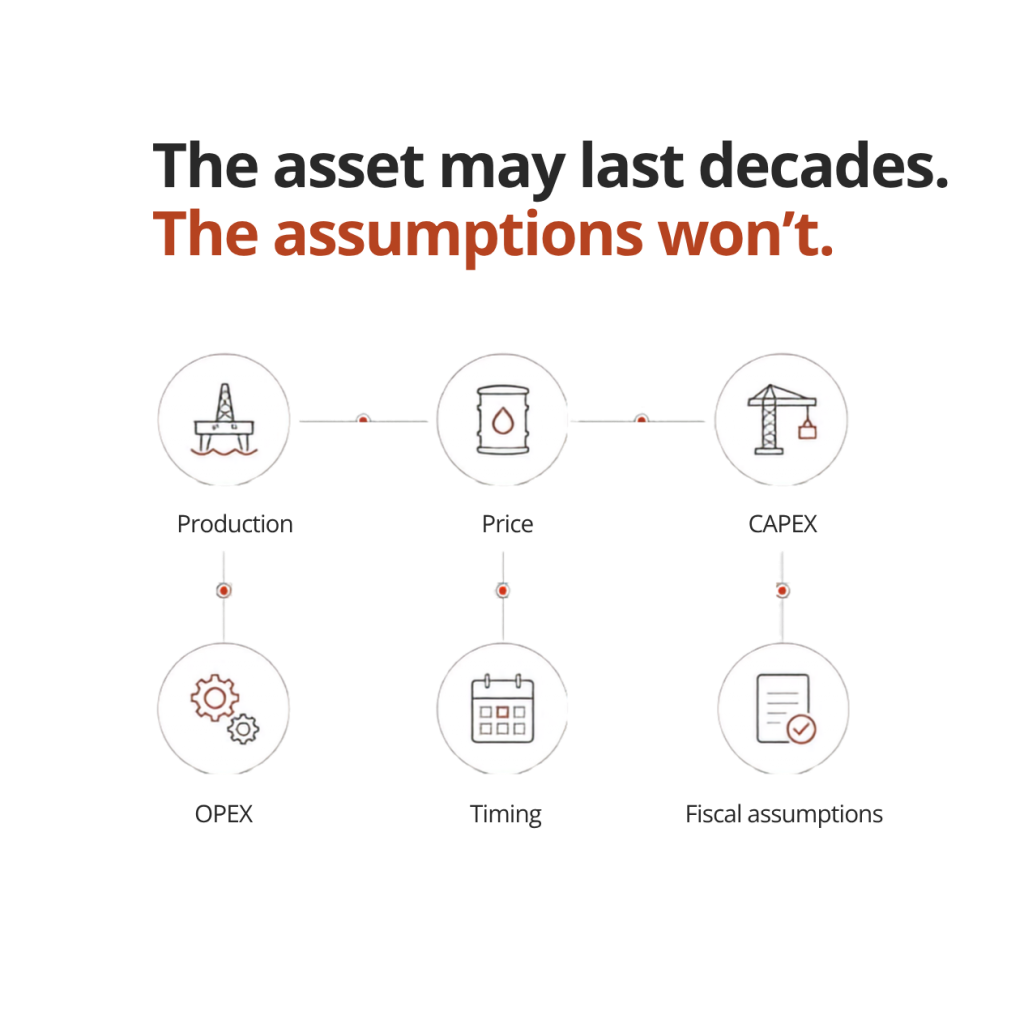
From production assumptions to asset economics
Driver | Planning question | Typical financial effect |
Production volume | What if output differs from plan? | Revenue, unit cost, cash flow |
Commodity price | What if realised price changes? | Revenue, margin, tax, cash |
CAPEX | What if project cost or timing changes? | Cash requirement, returns, funding |
OPEX | What if operating cost changes by asset? | Margin, field economics |
Timing | What if first production or shutdown moves? | Cash timing, NPV, funding |
FX | What if cost and reporting currencies move? | Cost base, earnings, cash |
Tax/fiscal | What if the fiscal regime changes? | Tax charge, project economics |
Decommissioning | What changes at end of life? | Long-term cash requirement |
In conclusion:
In the end, the challenge of the 50-year asset is not forecasting further into the future, but building a planning approach that remains usable as that future changes. The organisations that manage this well are not relying on static models or isolated forecasts; they are working with connected, driver-led architectures that allow assumptions to move and impacts to be understood quickly. In a market defined by volatility, the advantage does not come from being right once, but from being able to adjust continuously with control and clarity. That is what turns long-range planning from a theoretical exercise into a practical tool for decision-making.
Frequently Asked Questions
How long does an Oracle EPM Planning implementation take for an oil and gas company? Most upstream Oracle EPM Planning implementations take between 12 and 20 weeks, depending on the number of source systems being integrated and whether the build includes both in-year and life-of-field forecasting. Projects that integrate quantity data (BOE, MSCF, therms) alongside financials, or that connect to multiple ERP and production systems, sit toward the longer end of that range. A phased rollout, core financial planning first, quantity and scenario modelling second, is often the fastest way to get value into finance teams’ hands early.
What’s the difference between in-year and life-of-field forecasting? In-year forecasting covers the current financial year at monthly or quarterly granularity and is used for near-term budget control and variance management. Life-of-field forecasting spans the full production life of an asset, often decades and supports strategic decisions like investment timing, portfolio valuation and decommissioning planning. The two need to draw on the same underlying assumptions and ownership rather than existing as separate, unreconciled models.
Can Oracle EPM integrate with SAP and EnergySys? Yes. Oracle EPM Planning can integrate with both SAP and EnergySys as source systems, pulling in financial and operational data to feed a single forecasting model. In GKEPM’s implementation for NEO, this integration allowed financial and quantity forecasting including production units like BOE, MSCF and therms, to run from a shared, governed dataset rather than separate spreadsheets.
What is a Planning Architecture Review? A Planning Architecture Review is an assessment of how an organisation’s production, financial and scenario data currently connect across spreadsheets, source systems and reporting tools to identify where manual work, reconciliation effort or decision delay is being created. It typically results in a clear picture of where the current setup is working, where it’s creating risk, and what a more connected Oracle EPM Planning architecture would look like for that business.
How resilient is your current planning architecture?
GKEPM can review the way production, financial assumptions, scenarios and source systems connect today and identify where the model may be creating unnecessary manual work or decision delay.

Why most finance teams aren’t AI ready

Simplifying data transfers